
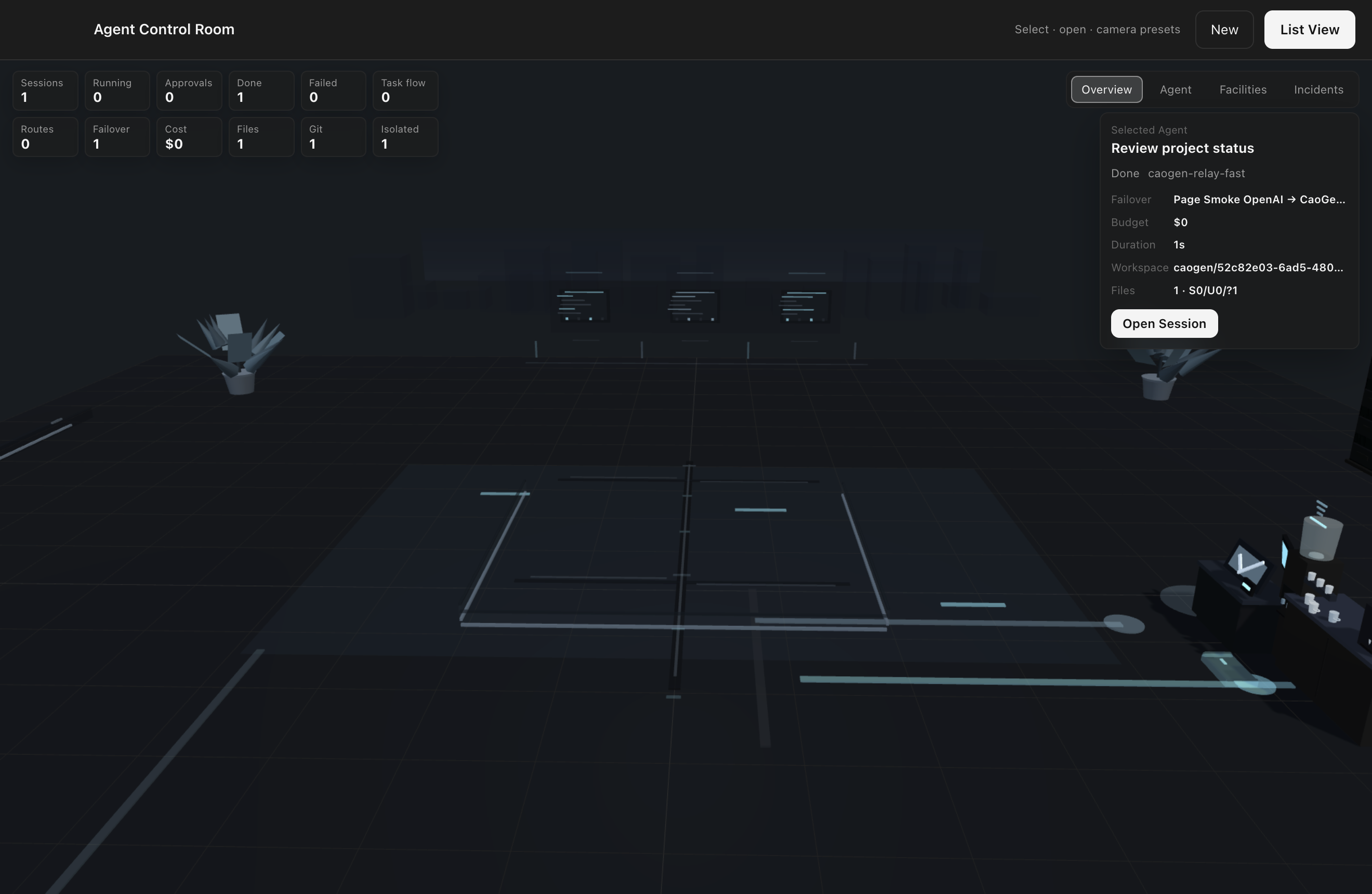
CaoGen 3D Agent control room showing real tasks, approvals, and workspace state
CaoGen 1.0 product vision · Formal acceptance remains open

CaoGen 1.0 Vision

Turn a conversation into complete work that can recover, be reviewed, and be accepted.

Assistant and Studio are two experiences over the same Project, Goal, WorkItem, Run, Artifact, Evidence, and Approval state. This page defines 1.0 completion; it is not a capability promise for the current Beta.

Current v0.1.6 Beta · 21 of 64 P0s formally verified

Start with two experiences

One kernel, two experiences

Keep simple work simple. Expand complex projects at any time.

Assistant and Studio share the same project, session, and run state. Switching modes must not restart work or lose context.

Assistant Partially complete

Focus on the goal, progress, and result

For office, education, research, and everyday knowledge work, with providers, tokens, terminals, and DAG details hidden by default.

  • One input for files, images, and sources
  • Automatic compute selection
  • Approvals, citations, and artifacts stay visible
Studio Partially complete

Expand the full delivery control plane

For product, engineering, solo-company, and complex project work, with Goals, WorkItems, digital workers, cost, diffs, evidence, and approvals.

  • Review plans, permissions, and budget
  • Inspect routing, tools, and workspaces
  • Handle repair, retest, and delivery

24 end-state capabilities · 6 system surfaces

Not a feature pile. An operating system that owns work state.

These six groups cover the complete 1.0 capability system. They describe the end state, while status labels remain tied to formal acceptance evidence.

01 Partially complete

Experience and work objects

Everyday and professional users share the same Project, Goal, WorkItem, Run, Artifact, and approval state.

  • Assistant mode
  • Studio mode
  • Lossless Assistant / Studio switching
  • Unified ProjectWorkspace
  • Goals and lightweight project management
02 Partially complete

Digital workers and compute routing

Digital workers are internal CaoGen role instances. Models are replaceable compute used by ModelAttempts.

  • Internal digital workers
  • Automatic team formation and assignment
  • Automatic cross-provider model routing
  • Complete recovery ladder
03 Partially complete

Native runtime and persistent ledgers

CaoGen owns execution semantics, context, and state. Protocol adapters cannot bypass permissions or the effect ledger.

  • CaoGen Native Runtime
  • OpenAI and Anthropic protocol adapters
  • Canonical Context Ledger
  • Workflow Ledger
  • Local Supervisor
04 Partially complete

Tools, artifacts, and trusted delivery

An Agent completion claim is not completion. Effects, artifacts, evidence, and acceptance must be queryable, reconcilable, and recoverable.

  • Tools and workbench
  • Artifact Graph
  • Evidence and Acceptance
  • Trust Kernel and Effect Ledger
  • Permissions and credential security
05 Partially complete

Learning, automation, and truthful visualization

Automation, memory, Skills, and the 3D digital team may project real work state only. They must not fabricate execution.

  • Routines, memory, and Skill learning
  • Watercolor light-anime 3D digital team
  • Observability and cost
06 Building for 1.0

Data lifecycle and release engineering

Migration, export, deletion, upgrades, and formal release assets must be reversible, verifiable, and credential-free.

  • Data migration, export, and deletion
  • Signing, notarization, SBOM, upgrades, and release asset verification

CaoGen 1.0 target workflow

From a Goal to a Diff, PR, and delivery package.

These ten stages define the complete 1.0 delivery state machine. The current release contains several foundations but does not yet persist and formally accept the entire chain.

  1. 01

    Goal

    Persist the objective, boundaries, budget, approvals, risks, and Acceptance criteria.

  2. 02

    Research and sources

    Collect traceable sources, facts, constraints, unknowns, and research evidence.

  3. 03

    Requirements

    Turn research into scope, priority, contracts, and requirements that can be accepted.

  4. 04

    Design artifacts

    Create architecture, interaction, visual, data, and decision artifacts with version relationships.

  5. 05

    Implementation plan

    Split WorkItems, dependencies, owners, resources, risks, and verification gates.

  6. 06

    Isolated development

    Execute tools in controlled directories or worktrees, record Effects, and produce artifacts continuously.

  7. 07

    Independent review

    An independent role inspects scope, sources, diffs, permissions, cost, risk, and effects.

  8. 08

    Repair

    A failed review creates a repair WorkItem while preserving the failure reason and original evidence.

  9. 09

    Testing and Acceptance

    Tests, screenshots, remote state, or user approval become Evidence. Completion follows only after retest passes.

  10. 10

    Diff / Commit / PR / delivery package

    Bundle changes, artifacts, evidence, cost, risks, remaining work, and verifiable release assets.

Product truth

The end-state requirements are not the current completion state.

CaoGen 1.0 has not reached stable release criteria. Of 64 PRD P0s, 21 are verified, 17 are partially complete, 25 remain project targets, and 1 has only a foundation. Evidence without formal acceptance is not promoted into the website's verified count.

Formal status: 2026-07-23
Verified

21 verified

Only P0s that pass formal acceptance with traceable evidence enter the verified count. The public release remains v0.1.6 Beta.

Partially complete

17 partially complete

Code, UI, or targeted evidence exists, but complete contracts, recovery, cross-provider continuity, release binding, or human workflows remain open.

Project targets

25 project targets

The end-state capability system defines 1.0 completion. It does not mean the current product already closes Native Runtime, Context, Artifact, Acceptance, and Supervisor loops.

Foundation only

1 foundation only

A minimum security foundation exists, but complete scoping, process isolation, egress verification, and formal acceptance remain open, so it is not counted as verified or partially complete.

After 1.0

Remote, cross-device, and multi-user work

Remote Supervisors, cloud Runners, desktop-closed execution, cross-device takeover, multi-user and organization policy, business connectors, Portfolio/Gantt, template markets, SSO/SCIM, and private deployment are end-state extensions.

Explicitly excluded

No external Agent launcher or universal collaboration suite

CaoGen does not treat Codex, Claude Code, or Gemini CLI as digital workers, build foundation models, replace complete Jira, HR, CRM, ERP, Office, chat, or meeting products, fabricate work with random animation, or claim transactional exactly-once for arbitrary external systems.

Real work state in the CaoGen 3D Agent control room

Real state visualization

Not decorative animation,
but a work control plane.

The current 3D control room already reads real session, task, approval, cost, provider, worktree, and Git state. The watercolor digital team is a clearly labeled 1.0 target.

Return to the current product

A verifiable definition of done

Vision must resolve into requirements, evidence, and acceptance.

The PRD defines the functional boundary and the acceptance matrix defines required evidence. Implementation without formally bound evidence is never promoted into the verified count.